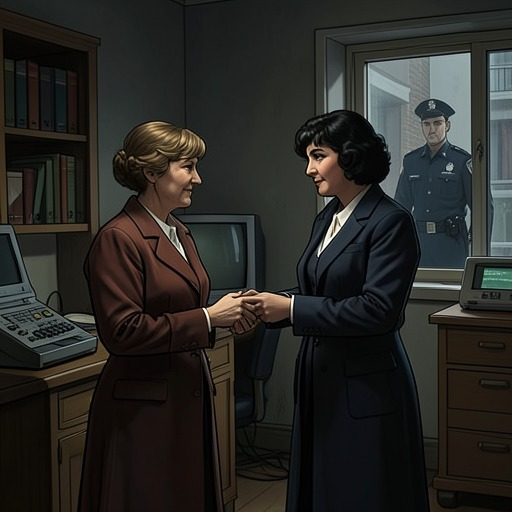
Grace and Bud Harris’s intimacy and complicity in the witness’s death
American RustGrace Poe and Bud Harris’s intimacy becomes complicity when Grace silently accepts the possibility that Harris will kill the man who can testify against her son, Billy Poe. Their connection is conveyed through a private gesture and a shared, unspoken understanding: Grace never directly tells Harris to act, but she wants the witness dead and knows that withholding the request does not absolve her of responsibility.
Intimacy and Uneasy Understanding
As Harris leaves, he thinks of Grace asleep at home. He had kissed her before departing; because she did not wake, he concludes that she does not understand what she wants him to do. The moment suggests closeness, but not certainty or open agreement. Harris reads her sleeping silence as evidence of a gap between them even as he carries her into his thoughts on the way to the station.
Grace’s later reflections complicate that interpretation. She knows Harris may be going to kill the man, and recognizes that she wants him to do so. What passes between them is not a plainly spoken plan but an understanding neither can honestly treat as someone else’s decision.
The Witness and Billy Poe’s Case
The immediate pressure on the relationship is the danger to Billy. Harris has hidden Billy’s jacket, which could connect him to the fatal incident at the machine shop. He tries to persuade Billy to explain what happened and identify who else was present, presenting the account as a possible route to a self-defense case at trial. His concern for Billy therefore operates alongside his decision to conceal evidence and his willingness to bend ordinary enforcement in the boy’s favor.
Grace understands that the man Harris might target has gone to the police, while Billy has not. She admits to herself that she does not know exactly what either man did, or what Harris has done; nevertheless, she wants the witness dead so that Billy can live. Her reasoning shifts from uncertainty about guilt to a mother’s determination to protect her son, making loyalty rather than a settled account of the facts the basis of her desire.
Silence as Complicity
Grace insists to herself that she did not actually tell Harris what she wanted and that he must make his own decisions. She immediately recognizes this as self-deception: she believes they both know what is at stake, and that an act Harris commits under this understanding would also implicate her. The distinction between giving an order and silently consenting remains important, but it cannot restore her innocence in her own judgment.
The relationship thus joins intimacy to moral responsibility without making either character’s intentions entirely transparent. Harris has already acted to shield Billy by hiding the jacket, while Grace’s unspoken wish presses that protective loyalty toward lethal action. Her final question about what Billy would have to do before she stopped wanting him protected exposes the cost of that devotion: she is prepared to subordinate the witness’s life, and her own moral limits, to her son’s survival.